Posts

On enforcing fiscal responsibility through fully-amortized loans

The main idea: switching government (or at least regional) borrowing to fully amortized schedules only would greatly limit the propensity to acquire leverage beyond reason.   0. Posts on this blog are ranked in decreasing order of likeability to myself. This entry was originally posted on 16.10.2021, and the current version may have been updated several times from its original form.   1. Problem: balloon loans 1.1 As far as I know, all borrowing taken out by governments the world over is repaid in bullet / balloon format, where the principal is fully repaid in one single payment at the end of the loan term, and only interest is payable up until that time. Some of those loans run for 50 years, just so we are clear. 1.2 At the other end of the repayment schedule spectrum, you find a fully amortized loan, whereby the borrower repays both the principal and interest on it in a series of equal repayments throughout the term of the loan (ask Excel). The issue and solution should ...
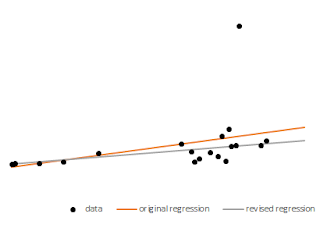
On removing outliers

Image
The main idea: iteratively replacing the datapoint most distant from the expected by the latter allows a model to account for outliers without ignoring them.    0. Posts on this blog are ranked in decreasing order of likeability to myself. This entry was originally posted on 17.10.2021, and the current version may have been updated several times from its original form. 1.1 Another technique which would be rather obvious, just writing about it as I don’t remember encountering it. The application to claims reserving could be a bit more original, that’s coming in a next post. 1.2 So, a technique that would help to smooth out any outliers in your dataset (as long as you have a model of the underlying pattern, which if you don’t, how do you know that you even have outliers?) is to iteratively replace the datum that diverges by most (absolute value or percentage, depending on context) by the expected datum by the latter. Recalculate the model parameters given the new data, and re...

On perpetual insurance

The main idea: proposing an insurance schedule whereby one premium is paid and cover continues indefinitely until a claim is made as a way to help with products afflicted by moral hazard.  0. Posts on this blog are ranked in decreasing order of likeability to myself. This entry was originally posted on 25.05.2022, and the current version may have been updated several times from its original form. 1.1 Here’s the idea: insurance that requires you to pay premium once, and rolls over forever. Until you make a claim, that is, whereupon the policy lapses (the claim is still honoured of course). 1.2 To explain what value would this setup provide, let’s take the example of health insurance. 1.3 With health insurance, by the time you apply all safeguards aimed at keeping people from making spurious or just non-critical claims, you end up with a policy so complex that all flexibility and transparency is lost. And yet, health insurance only works if claimants limit themselves to making ...

On fair dueling standards

The main idea: proposing a duel of Russian Roulette as an improvement over the historical version that presents more balanced trade-offs to the participants.   0. Posts on this blog are ranked in decreasing order of likeability to myself. This entry was originally posted on 20.09.2022, and the current version may have been updated several times from its original form.   1.1 I am among those who look forward to the day in which the practice of the honorable duel will return, but the next time around we’d better have a new and improved version that suffers from fewer of the issues of the original. 1.2 It was easy to attack the practice as a mindless squander of youthful talent, a mere codification of the practice of vendetta from a time when the state did not rule over the aristocracy. 1.3 To this I’ll add that the practice as carried out amounted to a license of those quick of hand to libel as much as they liked. They could win every duel, and had de facto freedom to ch...

On milking the HLvM model [fluff piece]

The main idea: the Left gravitates towards a Corporatist and then Socialist Oligarchy, as the Right does towards an Interventionist Autocracy run by a strong man. 0. Posts on this blog are ranked in decreasing order of likeability to myself. This entry was originally posted on 25.04.2022, and the current version may have been updated several times from its original form. 0.1 I have not read De Jouvenel (they stopped asking us to attend the office, can't fit long from unless on the way there and from) though I am aware of many “in a nutshell” versions digested by others. Further, I have not read C.A. Bond either (unavailable, though I remember the blog) and there go the two authorities on the HLvM model. If below one finds any silliness that would have been easily avoided by anyone who had read either of them, now you know how it got there.    0.2 This post is a fluff piece, containing analysis and commentary but no proposed solution to some issue. I try to keep this sort of ...

On the perfect asset class for open market operations

The main idea: a Central Bank limiting open market operations to the acquisition and issuance of its own shares would suffer few of the issues that plague the current alternatives.  0. Posts on this blog are ranked in decreasing order of likeability to myself. This entry was originally posted on 06.07.2022, and the current version may have been updated several times from its original form. 1.1 Those of us who prefer monetary matters to be managed by open market operations instead of interest rates are presented with the issue of asset quality. 1.2 Will there be enough assets of good quality to buy to increase monetary supply as much as one may need to? Isn’t buying treasuries just monetizing debt? Even if not, the whole debate around treasuries being money anyway is still live and, worst case scenario, open market operations are just buying money with money. 1.3 Moreover, isn’t buying stocks market intervention? Buying up insane quantities of mortgage-backed securities sure seeme...

On explaining links between monetary policy and interest rates [fluff piece]

Image
The main idea: modeling an inclined line whose angle is the interest rate and whose starting and ending points are monetary circulation volumes now and in the future explains a slew of otherwise peculiar relationships between interest rates and monetary policy.  0. Posts on this blog are ranked in decreasing order of likeability to myself. This entry was originally posted on 09.12.2021, and the current version may have been updated several times from its original form. 0.1 This post is a fluff piece, containing analysis and commentary but no proposed solution to some issue. I try to keep this sort of stuff to a minimum as commentary for commentary’s sake is not the point of this blog.   1. Setting the true risk-free interest rate 1.1 Here’s a thought experiment. Suppose the monetary authority (and it can only be the monetary authority) decides to issue consols, bonds that will pay out a set amount every month forever. It sets the price and – this is crucial – commits to...